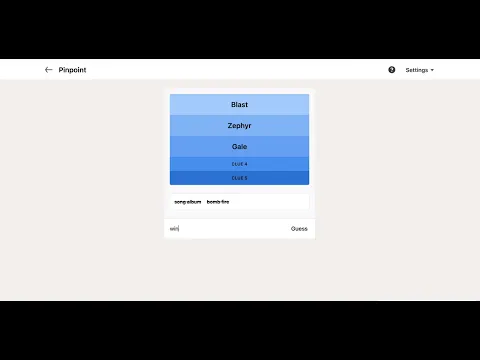
LinkedIn Pinpoint #771 Answer & Analysis
Stuck on LinkedIn Pinpoint 771? What connects Blast, Zephyr, Gale, Gust, and Breeze—and why? We've got you covered! This clean thematic category is a perfect test of your pattern recognition. Try our interactive hints first, then reveal the 30s expert logic and answer below to save your streak!
LinkedIn Pinpoint 771 Clues & Answer
💡 Hover (desktop) or tap (mobile) each clue to see how it connects to the answer
#1
Sets a theme of powerful, moving air, though it could be a red herring pointing toward explosions.
#2
Immediately refines the category. It's the opposite of "Blast," proving the theme is a spectrum, not just intensity.
#3
A classic meteorological term that solidifies the "wind" theme and confirms the high end of the scale.
#4
Adds another layer to the category by introducing a term defined by its short, sudden nature.
#5
An everyday term for light wind that makes the category unmistakable and locks in the solution.
Answer: Terms for wind conditions (varying duration and intensity)!
LinkedIn Pinpoint #771 Expert Logic
🧠 Expert Logic Walkthrough
When Blast popped up, my mind immediately went to two places: an explosion, or a sudden, forceful rush of air. "A blast of cold air" is a common phrase, so the idea of weather was definitely on the table from the start.
Then came Zephyr. This is a more poetic, specific word. My first instinct was to connect it to Blast, but they're almost opposites. A blast is powerful, while a zephyr is a gentle, mild wind. Wait a minute... if they're opposites on a spectrum, maybe the category isn't "strong things" but the spectrum itself? The common denominator is wind.
That's where it clicked. The third clue, Gale, fit the wind theory perfectly. A gale is a very strong wind, often used in maritime forecasts. So now we have a strong wind (Gale), a forceful rush of wind (Blast), and a gentle wind (Zephyr). The pattern was becoming crystal clear.
The final two clues, Gust and Breeze, were the victory lap. A Gust is a sudden, brief increase in the speed of the wind, adding a time dimension to the puzzle. And Breeze is perhaps the most common word for a light wind, making the set feel complete and accessible. All five words are distinct meteorological terms describing the movement of air at different intensities and durations. What a satisfying puzzle!
Experience & Summary
This puzzle was a classic example of category refinement. It started with a broad term ("Blast") that could have multiple meanings and then used increasingly specific clues ("Zephyr," "Gale") to force you to narrow your focus from "forceful events" down to the precise category of "wind conditions."
🎯 Category: Pinpoint 771
Terms for wind conditions (varying duration and intensity)!
🔍 Semantic Analysis: Blast, Zephyr & More
| Clue | Logical Role | Why it fits |
|---|---|---|
| Blast | The Intense Starter | Sets a theme of powerful, moving air, though it could be a red herring pointing toward explosions. |
| Zephyr | The Gentle Counterpoint | Immediately refines the category. It's the opposite of "Blast," proving the theme is a spectrum, not just intensity. |
| Gale | The High-Intensity Confirmation | A classic meteorological term that solidifies the "wind" theme and confirms the high end of the scale. |
| Gust | The Duration Qualifier | Adds another layer to the category by introducing a term defined by its short, sudden nature. |
| Breeze | The Common Validator | An everyday term for light wind that makes the category unmistakable and locks in the solution. |
📊 Difficulty Rating
2.2 / 5.0
This was a fairly straightforward puzzle. The primary challenge was moving past the initial, more aggressive definition of Blast. Once Zephyr appeared, the connection to wind became very strong for anyone familiar with the word. The subsequent clues simply reinforced a pattern that was already quite clear.
📜 Historical Pattern
Today’s puzzle is a perfect example of the Specialty Set pattern. This pattern groups together specific nouns or terms that belong to a well-defined, often technical or niche, category. It's less about wordplay and more about your knowledge of a particular subject.
Similar Pinpoint Examples:
- Pinpoint #694: Marble, Obsidian, Slate, Granite, Sandstone → [Types of rock!]
- Pinpoint #508: Combinatorics, Topology, Calculus, Statistics, Geometry → [Subjects in mathematics]
- Pinpoint #461: Moat, Dungeon, Drawbridge, Turret, Keep → [Parts of a castle]
👉 Learn more about “Specialty Set” pattern.
💡 Lessons Learned From Pinpoint 771
- Don't Over-Index on the First Clue: Blast could have led you down a rabbit hole of explosions or sounds. Always wait for the second or third clue to establish a reliable pattern.
- Look for the Spectrum: The clues weren't synonyms; they represented a range from gentle (Zephyr) to intense (Gale). Recognizing this spectrum is a powerful way to confirm a category.
- Vocabulary is a Superpower: Knowing a less common word like Zephyr was the key to unlocking this puzzle early. Expanding your vocabulary directly translates to better Pinpoint performance.
- Validate with the Familiar: The inclusion of everyday words like Breeze and Gust served to confirm the more technical or poetic terms, making the answer certain.
🌟 Trivia
The word Zephyr has a fascinating origin. In Greek mythology, Zephyrus was the god of the west wind. He was considered the gentlest and most favorable of the winds, often associated with the arrival of spring. So, a zephyr isn't just any light wind; it's historically a soft, life-bringing breeze.
🔥 Hot News
As the world grapples with climate change, understanding wind conditions has never been more critical. Recent reports on the expansion of offshore wind farms highlight how engineers must account for everything from a gentle breeze to destructive gale-force winds when designing turbines. This puzzle is a great reminder that the terms we use casually, like gust and blast, are precise data points for meteorologists and engineers shaping our green energy future.
🎬 30s Logic Breakdown
Rapid Recap: Watch our focused logic video below to see the connection in action. We start with the forceful weather concept of "Blast," bridge it to "Zephyr" via the thematic link "wind," and then validate it through the diverse worlds of meteorology, sailing, and everyday language. It's a perfect example of how a single category can contain words that seem like opposites but actually define a spectrum.
👉 Watch the pinpoint 771 video walkthrough.
❓ FAQ
What is the Beaufort Wind Scale?
The Beaufort Scale is an empirical measure that relates wind speed to observed conditions at sea or on land. It formalizes many of today's clues, with "Breeze," "Gale," and "Storm" (a stronger form of "Blast") having specific numerical ranges.
Is 'Zephyr' a common word?
It's not as common in everyday conversation as "Breeze" but is frequently used in literature, poetry, and brand names (like the Lincoln Zephyr) to evoke a sense of gentleness and smoothness. Its roots are in Greek mythology.
How is a 'gust' different from a 'blast'?
A gust specifically refers to a brief, sudden increase in wind speed that lasts for a very short time. A blast is a more general term for a strong rush of wind or air, which could be more sustained than a gust.
Could the answer have just been 'Types of Wind'?
Yes, that would have been a correct, if slightly less precise, answer. The official answer, "Terms for wind conditions (varying duration and intensity)!" is a higher-level solution because it correctly identifies why these different words exist—to describe the specific characteristics of the wind.
Watch the logic walkthrough